The Defined CRM
Technical Case Study - Building an Enterprise-Grade CRM for Home Services
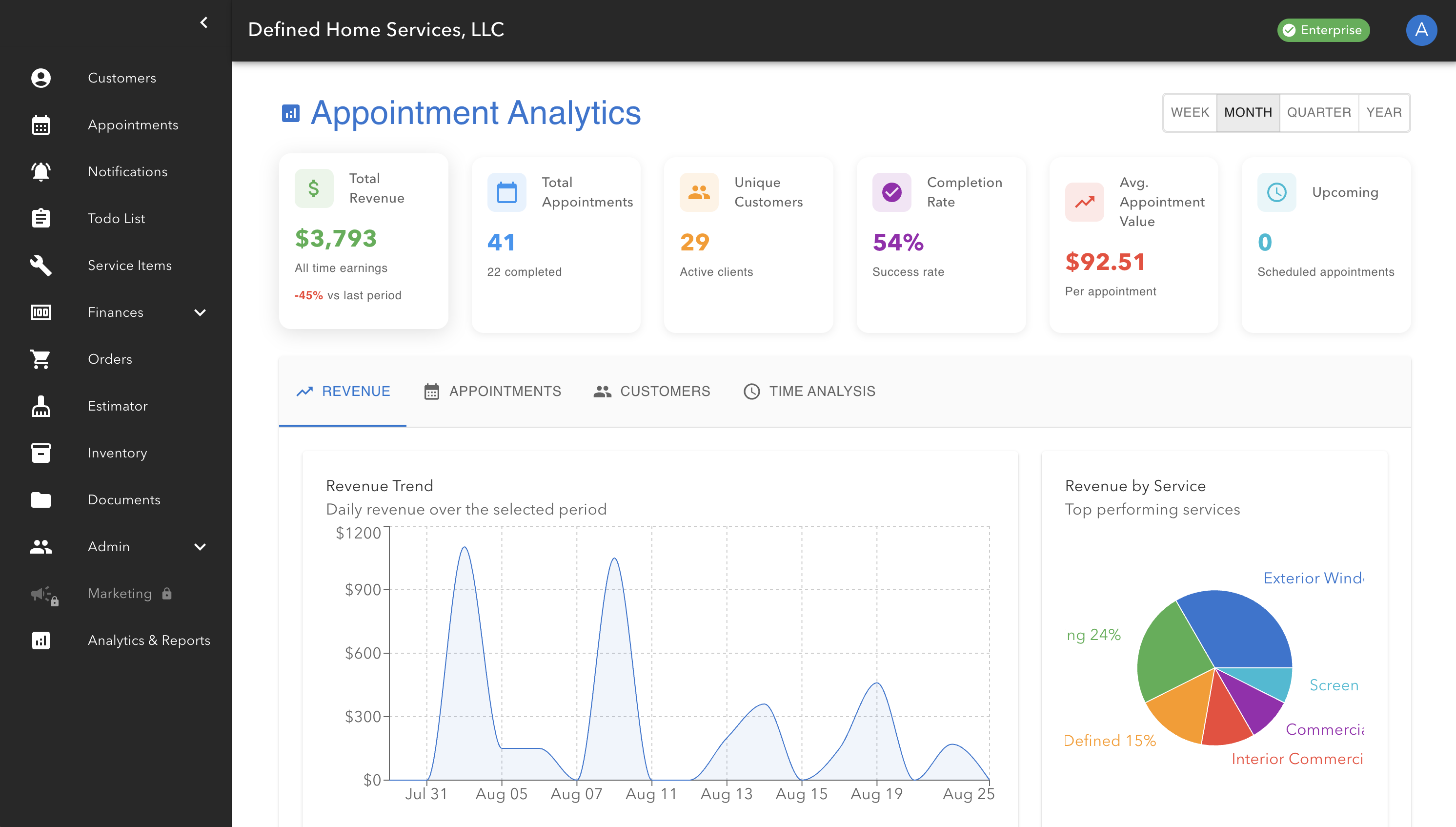
The Challenge
Home service businesses face unique operational challenges: coordinating field teams, managing recurring appointments, processing payments on-site, tracking leads from multiple sources, and maintaining customer relationships across years of service. Existing CRM solutions either lack industry-specific features or are prohibitively expensive for growing businesses.
100K+
Lines of Code
200+
API Endpoints
80%+
Test Coverage
99.9%
Uptime
The Solution
I architected and developed a comprehensive, production-grade CRM platform specifically designed for home service businesses, with features tailored to their unique workflows.
Technical Deep Dive
Neighbor Notification Marketing
Built a unique feature for hyperlocal marketing:
- Reverse geocode completed job addresses to find neighbors within configurable radius
- Generate personalized postcards via PostGrid API
- Technologies: Melissa Data API, Google Maps, PDF generation
- Business Impact: 15% conversion rate on neighbor campaigns
Multi-Tenant Architecture
Designed a scalable system supporting multiple companies:
- Company-level data segregation in Firestore
- Subscription plan-based feature gating
- Role-based access control with granular permissions
- Single Docker deployment serving multiple tenants
Performance Optimization
Achieved sub-200ms response times:
- Redis caching with intelligent cache invalidation (40% fewer database queries)
- Algolia search for full-text search offloading
- Optimized Firestore queries with composite indexes
- Cursor-based pagination for large datasets
Webhook Integration Framework
Built a flexible third-party integration system:
- Supported: GoHighLevel, ZenBooker, Acuity Scheduling
- Automatic customer creation with duplicate prevention
- Event-driven processing with retry mechanisms
- Reliability: 99.9% successful webhook processing
Development Approach
Test-Driven Development
- Comprehensive test suite using Jest and React Testing Library
- BDD approach with Given-When-Then structure
- Integration tests for API endpoints
- E2E tests with Playwright
API-First Design
- 200+ RESTful endpoints with Swagger documentation
- Consistent error handling and response formats
- Request validation and sanitization
- Rate limiting and security middleware
Modular Architecture
- 60+ independent service modules
- Clear separation of concerns
- Dependency injection for testability
- Reusable utility functions
Technology Choices & Rationale
Why Firestore?
- Real-time synchronization for collaborative features
- Excellent scalability without infrastructure management
- Native integration with Firebase ecosystem
- Offline support for mobile app
Why Redis?
- Significantly reduced database load (40% fewer queries)
- Fast session management
- Pub/sub for real-time features
- Simple cache invalidation patterns
Why Docker?
- Consistent deployment across environments
- Easy scaling of individual services
- Simplified development onboarding
- Production parity
Full Stack
- Node.js + Express backend
- React + TypeScript frontend
- Firebase Firestore & Auth
- Stripe Connect for payments
Challenges Overcome
PDF Generation Memory Issues
Problem: Large invoices causing out-of-memory errors
Solution: Switched to streaming PDF generation with pdf-lib
Stripe Connect Complexity
Problem: Payment splitting between platform and service providers
Solution: Implemented Stripe Connect with application fees and transfers
Twilio Rate Limiting
Problem: SMS reminders hitting rate limits during peak times
Solution: Implemented queue system with configurable rate limiting
Results & Impact
Performance Metrics
<200ms
API response time (95th percentile)
40%
Database queries reduction via caching
80%+
Test coverage across critical business logic
99.9%
Uptime over 12 months
Business Metrics
$100K+
Monthly revenue processed per company
1000+
Appointments per month per company
100+
Employee accounts coordinated
15%
Conversion rate on neighbor marketing
Code Quality
100,000+
Lines of production code
Full
Swagger documentation for all endpoints
TypeScript
Type safety on frontend
Comprehensive
Error handling and logging
Future Enhancements
Mobile App Enhancement
Offline-first architecture with advanced data synchronization and conflict resolution.
Machine Learning Integration
Appointment duration prediction based on historical data and job types.
Advanced Route Optimization
Real-time traffic data integration for dynamic route planning and ETA updates.
Multi-Language Support
Internationalization for expanding into new markets and diverse customer bases.
White-Label Capabilities
Franchise operations support with customizable branding and isolated data environments.
Key Takeaways
This project demonstrates my ability to:
- Architect and build complex, production-grade systems
- Integrate multiple third-party APIs and services
- Optimize for performance and scalability
- Write clean, maintainable, well-tested code
- Make sound technical decisions balancing cost, complexity, and capability
- Deliver business value through technical solutions
Next Project